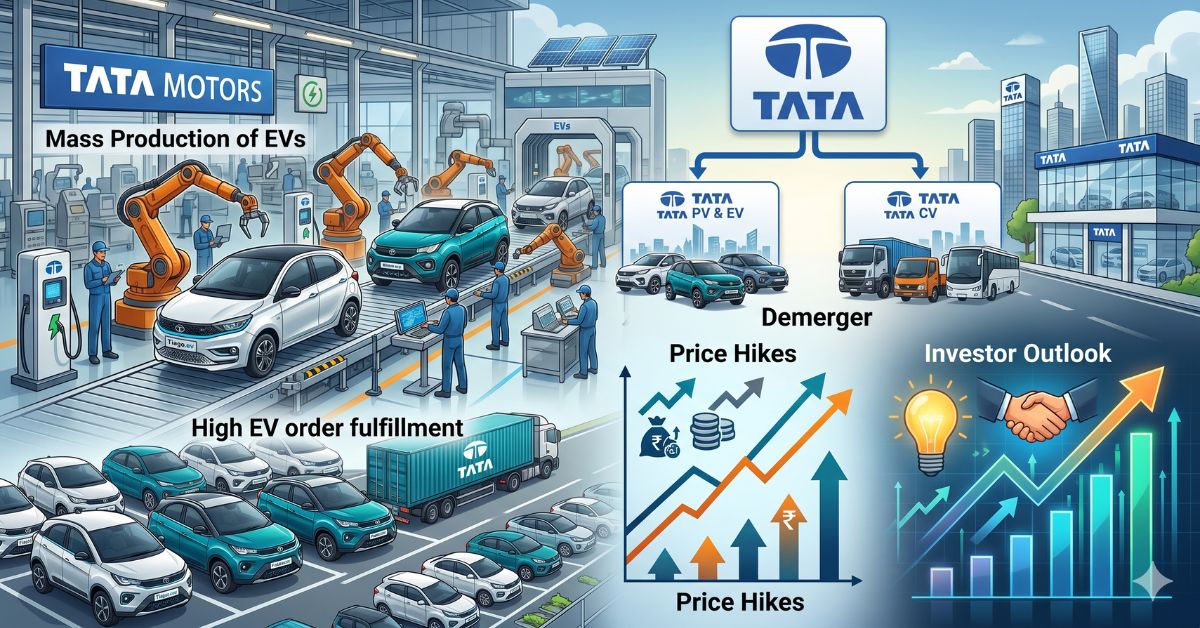
TATA Motors Shares 2026 shares are again in focus in 2026 as investors track fresh electric vehicle orders, the impact of the company’s demerger, price hikes, FY26 performance, and the future plan for Jaguar Land Rover. The latest trigger came after Tata Motors secured a large order for electric commercial vehicles, giving the stock a positive push in early trade.
For Indian investors, the story is not only about one-day share movement. It is also about how Tata Motors is now being valued after its business split into focused entities. The commercial vehicle business, passenger vehicle business, EV strategy, and JLR performance are all important parts of the wider picture.
What Happened?
TATA Motors Shares 2026 shares gained attention after the company announced orders for more than 3,400 electric commercial vehicles across freight, logistics, and passenger transport segments. The order includes small commercial vehicles, pick-ups, trucks, and buses.
Shares of Tata Motors Commercial Vehicles rose over 2% on June 22, 2026 to hit about ₹411 in the session, according to market reports. Investors saw the EV order as a positive sign for the company’s future in commercial vehicles, the move comes after.
The order is significant, because it means electric commercial vehicles are moving out of the pilot project world. Today they are used by companies for real business activities such as e-commerce delivery, logistics, FMCG distribution, mining, cement, steel and public transport.
Why Tata Motors Shares Are Different in 2026
One important point investors must understand is that Tata Motors is no longer being seen in the same simple way as before. After the approved demerger, the business structure became more focused.
The commercial vehicle business now operates under Tata Motors Ltd, while the passenger vehicle business is under Tata Motors Passenger Vehicles Ltd. The passenger vehicle side also includes Tata’s domestic car business, EV business, and the Jaguar Land Rover link.
This means investors now have two different stories to follow. One is the commercial vehicle story which is about trucks, buses, fleet demand, EV orders, infrastructure activity and operating margins. The second is the passenger vehicle and JLR story which is dependent on car demand, SUVs, EV launches, luxury vehicle sales, global markets and margins.
Key Details Behind the Latest Share Movement
The latest EV order is a major reason why Tata Motors Commercial Vehicles came into the spotlight. The company’s order book includes around 2,000 small commercial vehicles and pick-ups, about 900 trucks, and nearly 500 buses.
This order matters because commercial EVs can become a strong growth area in India. Many businesses want to reduce fuel costs, improve fleet efficiency, and meet cleaner transport goals. If Tata Motors can deliver these vehicles on time and maintain service quality, it may strengthen its position in the electric commercial vehicle market.
The company has experience with electric buses and small electric commercial vehicles. This gives some confidence to investors that Tata Motors is not starting this from scratch. Execution, charging support, service network, battery performance and cost control will, however, remain key.
Background: FY26 Performance and Dividend Update
Tata Motors Commercial Vehicles reported a strong Q4 FY26 performance. The company said its standalone quarterly revenue stood at ₹24.5K crore, up 22% year-on-year. EBITDA was ₹3.4K crore, up 35%, and the EBITDA margin reached 13.9%.
For the full FY26 year, standalone revenue stood at ₹77.4K crore, up 11%. The company also reported strong free cash flow and net cash for the domestic business. These numbers suggest that the commercial vehicle business is focusing on profitable growth rather than only chasing volume.
The board also recommended a final dividend of ₹4 per share, subject to shareholder approval. For long-term investors, dividend and cash flow are important because they show how well the company can generate money from its core business.
Price Hike From July 2026: Why It Matters
Tata Motors has also announced price increases across its commercial vehicle range by up to 2.5% from July 1, 2026. This is being done to partly offset higher input and commodity costs.
Tata Motors Passenger Vehicles has also announced a price hike of up to 1.5% on cars and SUVs, including EVs, from July 1, 2026.
For investors, price hikes can be both positive and negative. They may help protect margins if raw material costs are rising. But if demand is weak, higher prices can affect sales. This is why market reaction depends on whether Tata Motors can pass on costs without losing customers.
JLR Factor: A Big Reason for Stock Volatility
Jaguar Land Rover remains a major part of the Tata Motors passenger vehicle story. JLR has a strong luxury brand position, but its performance is also affected by global demand, China market weakness, US strategy, tariffs, supply chain issues, and cost pressure.
In June 2026, JLR’s profit recovery plan disappointed some investors because its margin forecast was lower than expected. This led to a sharp fall in Tata Motors PV shares earlier in the month. At the same time, some brokerages remain positive on JLR’s long-term growth because of its North America focus, cost-saving plans, and future product launches.
This mixed view explains why Tata Motors-related shares can move sharply in both directions. The company has strong brands and growth opportunities, but the global luxury vehicle business can be unpredictable.
Why It Matters for India
Tata Motors is one of India’s most important automobile companies. Its performance matters not only for shareholders but also for the larger auto industry, EV market, suppliers, fleet operators, and transport ecosystem.
The latest electric commercial vehicle order shows that India’s EV story is not limited to personal cars and two-wheelers. Buses, trucks, and delivery vehicles can also become a major part of the clean mobility shift.
As companies adopt more electric fleets, it can reduce fuel dependency and operating costs over time. It can also help India’s bid to cut emissions. But for this to happen India needs better charging infrastructure, battery reliability, finance options and service support.
Impact on Investors
For investors, Tata Motors shares in 2026 should be tracked with a balanced view. The commercial vehicle business is showing strength in margins, order flow, and cash generation. The EV order is also a positive signal.
But the passenger vehicle and JLR side still has some uncertainty. JLR’s margin outlook, global luxury demand, China weakness, and cost pressures can affect sentiment.
That means investors shouldn’t look at any one headline. They should watch quarterly results, order execution, sales numbers, margin guidance, global JLR updates and management commentary.
This article is for information only and should not be seen as investment advice. Stock market investments carry risk, and readers should consult a SEBI-registered financial advisor before making any decision.
What Happens Next?
Next important updates will be the rollout of the 3,400-plus electric commercial vehicle orders and the effect of July 2026 price hikes on demand.
Investors would also be looking out for Tata Motors’ upcoming quarterly results, commercial vehicle sales, EV fleet adoption and any update on JLR’s margin recovery plan. Market participants will also be watching for the company’s expected developments on the Iveco deal, which may have an impact on the commercial vehicle growth story.
Read More : Tekton SUV Vs. Nissan Petrol 2026
For the passenger vehicle side, new launches, EV demand, market share targets, and JLR’s international performance will remain key triggers.
Important Official Updates to Watch
1. Confirmed information is first available from Tata Motors’ official investor releases and exchange filings. Investors should also keep an eye out for announcements by NSE and BSE, quarterly results, dividend record dates, price hike notices and annual report updates.
Media reports can help shed light on the market reaction, but official filings are more reliable for final figures and company statements.
FAQs (TATA Motors Shares 2026)
Why are Tata Motors shares in focus in 2026?
Tata Motors shares are in focus because of new electric commercial vehicle orders, FY26 results, the post-demerger business structure, price hikes, and JLR-related updates.
Did Tata Motors receive a big EV order?
Yes, Tata Motors secured orders for more than 3,400 electric commercial vehicles across freight, logistics, and passenger mobility segments.
What is the Tata Motors demerger update?
After the demerger, the commercial vehicle business is under Tata Motors Ltd, while the passenger vehicle business is under Tata Motors Passenger Vehicles Ltd.
Is the latest EV order positive for Tata Motors?
The order is positive because it shows rising demand for electric commercial vehicles in India. However, actual impact will depend on delivery, margins, service support, and execution.
What are the main risks for Tata Motors shares?
Key risks include raw material costs, weak demand, JLR margin pressure, global market uncertainty, EV competition, and execution delays.
Should investors buy Tata Motors shares now?
This depends on the investor’s risk profile and financial goal. Readers should check official filings and consult a SEBI-registered financial advisor before investing.