The term “Pearl Harbor” is trending again, and many people are searching to understand what exactly happened and why it is still important today. This article explains the full story in simple English—covering the attack, its background, its global impact, and why it still matters, including for India.
What Happened at Pearl Harbor?
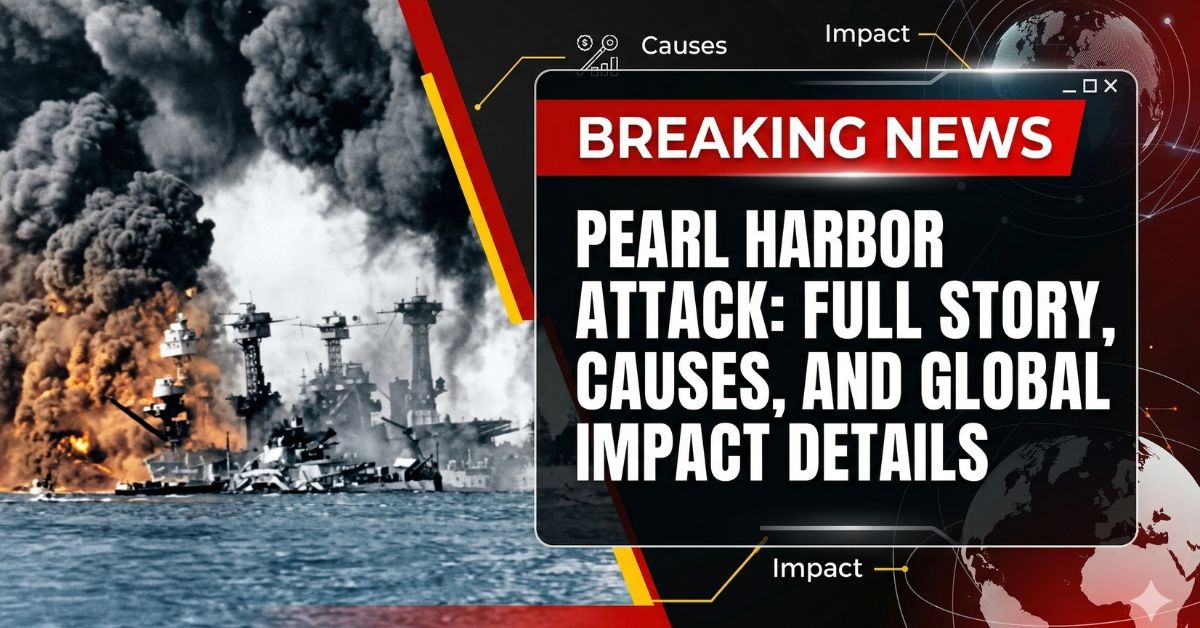
On December 7, 1941, a surprise military attack was carried out by Japan on the United States naval base at Pearl Harbor in Hawaii. The attack began early in the morning and lasted for about two hours.
Japanese aircraft launched from aircraft carriers targeted American ships, airplanes, and military installations. The aim was to weaken the U.S. Pacific Fleet so that Japan could expand its control in Asia without immediate resistance.
The attack caused heavy damage. More than 2,400 Americans were killed, and many ships and aircraft were destroyed or badly damaged. Several battleships sank, and airfields were hit hard.
Why Did Japan Attack Pearl Harbor?
To understand the attack, it is important to look at the situation before 1941.
At that time, Japan was expanding its influence in Asia, especially in China and Southeast Asia. However, the United States opposed this expansion and placed economic sanctions on Japan. These sanctions limited Japan’s access to oil and other important resources.
Japan believed that a sudden attack on Pearl Harbor would stop the United States from interfering in its plans. The idea was to delay American military action long enough for Japan to strengthen its position in the region.
Immediate Consequences of the Attack
The attack on Pearl Harbor changed global history overnight.
The very next day, December 8, 1941, the United States officially entered World War II. Until then, the U.S. had stayed mostly out of the war.
Soon after, Germany and Italy—Japan’s allies—declared war on the United States. This turned the conflict into a full-scale global war involving major powers from different continents.
Impact on World War II
Pearl Harbor became a turning point in World War II.
After joining the war, the United States increased its military production and sent troops to fight in both Europe and Asia. Over time, the U.S. played a key role in defeating Japan and its allies.
The war ended in 1945 after Japan surrendered. The events that followed included major battles in the Pacific and the use of atomic bombs on Hiroshima and Nagasaki.
Check out more: Iran Attacks Israel News
Why Pearl Harbor Still Matters Today
Even after more than 80 years, Pearl Harbor remains an important historical event for several reasons.
First, it shows how a sudden attack can change global politics instantly. It reminds countries of the importance of defense and preparedness.
Second, it is often discussed in relation to international relations and military strategy. Governments study the event to understand intelligence failures and how to avoid similar surprises.
Third, it remains a symbol of sacrifice and national unity, especially in the United States.
Relevance and Impact in India
Although Pearl Harbor was a U.S.-Japan event, its effects were global, including in India.
At the time of the attack, India was under British rule. When the United States entered World War II, it strengthened the Allied forces, which included Britain. This indirectly affected India, as many Indian soldiers were part of the British Indian Army.
India played a major role in supporting the Allied war effort. Indian troops fought in different regions, including Southeast Asia, where Japan was active.
The war also influenced India’s independence movement. After the war, Britain became weaker economically and politically, which helped speed up India’s path to independence in 1947.
Pearl Harbor in Modern Discussions
Today, Pearl Harbor is often mentioned in news and political discussions when talking about surprise attacks or national security threats.
It is also a key topic in education, documentaries, and films. Many people visit the Pearl Harbor memorial in Hawaii to pay respect to those who lost their lives.
In recent times, whenever global tensions rise, comparisons to Pearl Harbor sometimes appear in media and expert discussions.
What Happens Next in Terms of Global Awareness?
While Pearl Harbor is a historical event, its lessons continue to guide modern policies.
Countries now invest heavily in intelligence systems, surveillance, and defense planning to avoid sudden attacks. International cooperation and diplomacy have also become more important.
In India, discussions around national security, defense preparedness, and global alliances often include lessons from events like Pearl Harbor.
Frequently Asked Questions (FAQs)
1. What is Pearl Harbor known for?
Pearl Harbor is known for the surprise attack by Japan on the United States in 1941, which led to the U.S. entering World War II.
2. Why did Japan attack the United States?
Japan attacked because of rising tensions, economic sanctions, and its plan to expand in Asia without U.S. interference.
3. How many people died in the attack?
More than 2,400 Americans were killed during the Pearl Harbor attack.
4. Did Pearl Harbor start World War II?
No, World War II had already started in 1939. But Pearl Harbor brought the United States into the war.
5. How is Pearl Harbor connected to India?
India was part of the British Empire during the war, and Indian soldiers supported Allied forces after the U.S. joined the conflict.