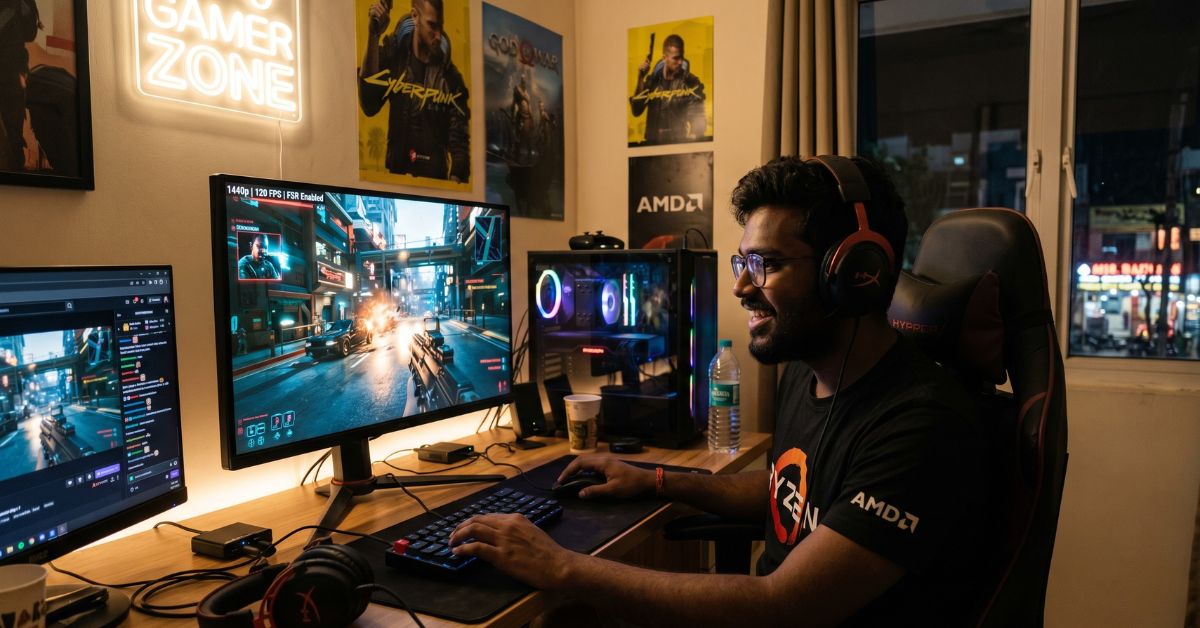
AMD FSR Upscaling 2026 has become an important topic for PC gamers, laptop buyers, and graphics card users in India. The reason is simple. Games are getting heavier, 4K gaming is becoming more common, and many users want better frame rates without spending too much on a new GPU.
In 2026, AMD’s FSR technology is no longer just a simple performance booster. It is moving deeper into machine learning and AI-based gaming features. The latest FSR upscaling system, earlier known as FSR 4, is now part of AMD’s wider FSR “Redstone” technology. This article explains what happened, what has changed, which GPUs are supported, why it matters for Indian gamers, and what can happen next.
What Happened to AMD FSR Upscaling in 2026?
AMD updated its gaming upscaling technology, called FSR, to version 2026. FSR is short for FidelityFX Super Resolution. It renders games at a lower internal resolution and then reconstructs the image to appear sharper on screen.
In simple words, your GPU does not have to render every frame at full native resolution. Instead, FSR helps create a clean and sharp final image while improving performance. This can increase FPS and make games feel smoother.
The big 2026 update is that AMD FSR Upscaling 2026 is now powered by machine learning on newer Radeon graphics cards. AMD has also connected it with other FSR “Redstone” features like frame generation, ray regeneration, and radiance caching.
What Is AMD FSR Upscaling?
AMD FSR upscaling is a gaming technology that improves performance and image quality. It takes a lower-resolution game image and reconstructs it into a higher-resolution output.
For example, a game may be rendered internally at a lower resolution and then upscaled to 1440p or 4K. This gives the player better FPS while still keeping the image sharp.
Earlier FSR versions used more traditional upscaling methods. The latest FSR upscaling uses machine learning on supported hardware. This helps reduce common problems like ghosting, blur, unstable edges, and loss of small details.
Key Details of AMD FSR Upscaling 2026
The most important change in 2026 is the shift toward ML-based upscaling. ML means machine learning. This allows the technology to better understand game frames and rebuild details more intelligently.
AMD has also renamed FSR 4 as FSR Upscaling. This makes it easier to separate the upscaling feature from other FSR “Redstone” features. So, when users see “FSR Upscaling” in 2026, it generally refers to AMD’s latest ML-based upscaling system.
AMD’s FSR “Redstone” includes four major parts. FSR upscaling improves image quality and FPS. FSR Frame Generation creates extra frames for smoother gameplay. FSR Ray Regeneration improves ray-traced visuals. FSR Radiance Caching is designed to improve lighting performance in advanced rendering.
For normal gamers, the main benefit is simple: better image quality and smoother gameplay in supported games.
Supported GPUs in 2026
AMD FSR upscaling with ML technology is available on Radeon RX 9000 Series and Radeon RX 7000 Series graphics cards. AMD has also confirmed that Radeon RX 6000 Series support is expected in 2027.
This is an important update because many Indian gamers still use older Radeon GPUs. The RX 7000 Series support makes the technology more useful for people who bought AMD graphics cards before the RX 9000 Series launch.
However, support can still depend on the game, driver version, and hardware configuration. Not every game will support every FSR feature in the same way.
Why AMD FSR Upscaling Matters
Gaming performance is a major issue for many PC users. New games often need powerful GPUs, more VRAM, and better cooling. In India, high-end graphics cards are expensive, so any technology that improves performance without requiring a full hardware upgrade becomes important.
FSR Upscaling can help users get more FPS from the same GPU. It can also make 1440p and 4K gaming more practical on mid-range systems. For esports players, smoother frame rates can improve the overall experience. For story-based games, better upscaling can make visuals look sharper without heavy performance loss.
It also matters because AMD competes with Nvidia DLSS. DLSS has been strong in AI upscaling, but AMD’s latest FSR updates show that the company is trying to close the gap.
Impact in India
For India, AMD FSR Upscaling 2026 can affect three main groups: PC gamers, gaming laptop buyers, and content creators.
PC gamers may get better value from Radeon GPUs, especially if they already use RX 7000 Series cards. Gaming laptop buyers may also pay more attention to AMD-powered devices if FSR support grows in popular games.
Indian gamers often compare GPU price, FPS, and long-term value before buying. If AMD continues to expand FSR support across more games and older hardware, Radeon graphics cards can become more attractive in the mid-range market.
This can also help gaming cafes and budget gaming PC builders. A system that can deliver smoother performance using upscaling may stay useful for a longer time.
Background and Context
AMD FSR Upscaling 2026 first introduced FSR as a performance-improving technology for games. Over time, it evolved with better image reconstruction and frame generation features.
The latest move is more serious because AMD is now using machine learning for better upscaling quality. This is similar in direction to Nvidia’s DLSS, although both technologies work differently and have different hardware requirements.
Earlier, many users liked FSR because it was widely available across different GPUs. But with ML-based FSR upscaling, the best experience is linked more closely to newer Radeon hardware. This is why GPU support has become a major part of the 2026 discussion.
How It Helps in Real Gaming
FSR Upscaling can help in heavy games where native resolution puts too much load on the GPU. In supported titles, players can choose different quality modes depending on what they want.
Quality mode usually gives better visuals with a smaller FPS boost. Performance mode gives more FPS but may reduce image quality slightly. Balanced mode sits between both.
The best setting depends on the game, monitor resolution, and GPU power. A 1080p player may not need aggressive upscaling, while a 1440p or 4K player may see more benefit.
Official Updates to Watch
The most important official updates to watch are AMD driver releases, GPUOpen SDK updates, and supported games lists. AMD Software: Adrenalin Edition drivers can play a major role because some games may receive FSR improvements through driver-side updates.
Game developers also need to integrate or support FSR features properly. This means users should not expect every game to instantly support the latest FSR features.
For Indian gamers, it is better to check three things before expecting FSR benefits: whether the game supports FSR, whether the GPU supports the required FSR version, and whether the latest AMD driver is installed.
What Happens Next?
The next major step will be wider support. If AMD brings smoother FSR upscaling to more GPUs and more games, it can increase the value of Radeon cards in 2026 and 2027.
RX 6000 Series users will especially watch the 2027 rollout. These GPUs are still used by many gamers, and official support can extend their life.
Another important area is handheld gaming. Many handheld gaming devices use AMD hardware. Better FSR support can improve battery-friendly gaming and smoother performance on smaller devices.
AMD may also continue improving image quality, frame generation, and ray tracing features. The real test will be how well these features perform in popular games, not just in technical demos.
Should Indian Gamers Care?
Yes, Indian gamers should care, especially if they use AMD Radeon GPUs or plan to buy a gaming PC or laptop in 2026.
FSR Upscaling can help improve performance without changing the whole system. It can also make mid-range GPUs more useful for modern games. However, users should not treat it as magic. Native rendering still matters, and game support is important.
Before buying a new GPU only for FSR, users should check supported games, reviews, benchmarks, and real-world performance for the exact graphics card model.
Final Takeaway
AMD FSR Upscaling 2026 is a big update for PC gaming. It’s a sign of AMD’s push into AI and machine learning-based graphics enhancement. This tech can make games look sharper and run more smoothly, especially on supported Radeon GPUs.
Read More: Nvidia Share Price 2026
For India, the biggest benefit is value. If AMD expands support properly, many gamers may get better performance without immediately upgrading to very expensive hardware.
Still, users should stay careful. FSR benefits depend on the game, GPU, driver, and settings. The best approach is to check official support and real gameplay tests before making any buying decision.
FAQs (AMD FSR Upscaling 2026)
What is AMD FSR Upscaling?
AMD FSR upscaling is a technology that improves game performance by rendering frames at a lower resolution and then rebuilding them into a sharper final image.
Is AMD FSR Upscaling the same as FSR 4?
Yes, AMD has renamed FSR 4 as FSR Upscaling to separate it from other FSR “Redstone” features.
Which GPUs support AMD FSR upscaling in 2026?
AMD FSR upscaling with ML technology supports Radeon RX 9000 Series and RX 7000 Series GPUs. RX 6000 Series support is expected in 2027.
Does FSR increase FPS?
Yes, FSR can increase FPS in supported games. The exact improvement depends on the game, GPU, resolution, and FSR quality mode.
Is AMD FSR better than Nvidia DLSS?
Both technologies aim to improve performance and image quality. Nvidia DLSS is known for strong AI upscaling, while AMD is improving FSR with ML-based features. The better option depends on the game and hardware.
Should I buy an AMD GPU because of FSR?
FSR is a useful feature, but it should not be the only reason to buy a GPU. Check price, raw performance, VRAM, power use, driver support, and game compatibility before buying.