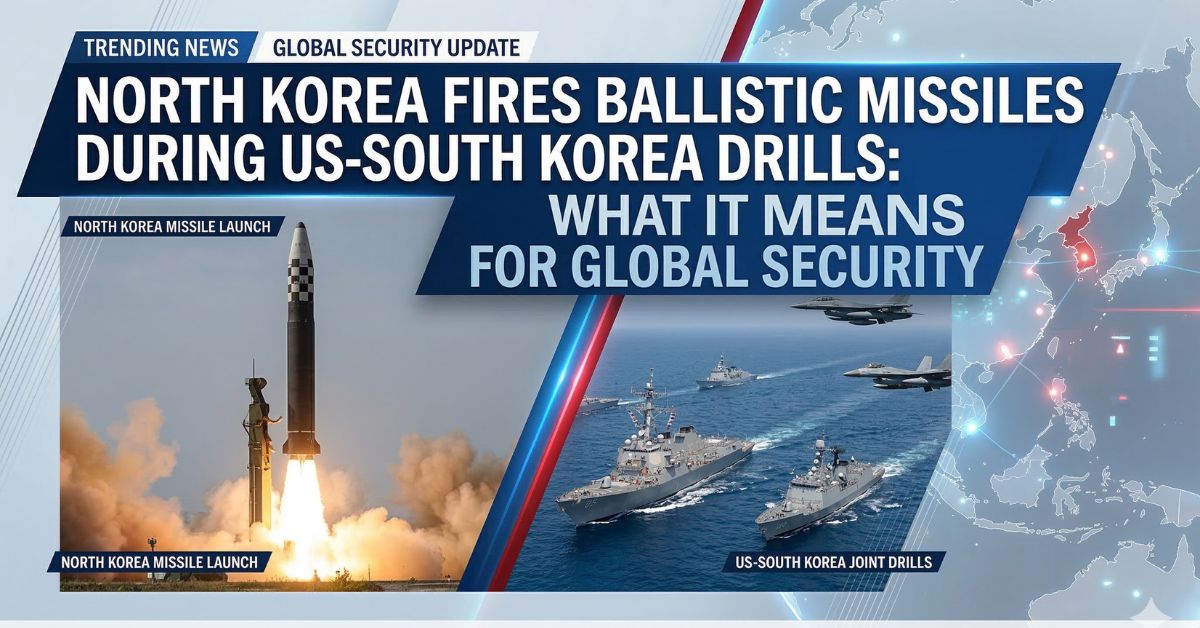
Tensions in East Asia have increased again after North Korea fired multiple ballistic missiles into the sea near the Korean Peninsula. The missile launches happened during ongoing military drills between the United States and South Korea, raising concerns about regional security and global stability.
This article explains what happened, why North Korea launched the missiles, how other countries responded, and what the situation means for the world and India.
What Happened: North Korea’s Latest Missile Launch
North Korea fired around 10 ballistic missiles toward the East Sea (Sea of Japan), according to South Korea’s military. The missiles were launched from the Sunan area near Pyongyang and traveled roughly 350 km before landing in the sea.
The launches were detected at around 1:20 PM local time, and Japan’s defense authorities also confirmed that at least one object believed to be a ballistic missile fell into waters outside Japan’s exclusive economic zone.
These tests are part of North Korea’s continuing missile program despite strict United Nations sanctions aimed at limiting its nuclear weapons development.
Key Details of the Missile Launch
| Detail | Information |
|---|---|
| Number of missiles | Around 10 ballistic missiles |
| Launch location | Sunan area near Pyongyang |
| Launch time | Around 1:20 PM local time |
| Estimated range | Around 350 km |
| Landing area | Sea of Japan / East Sea |
| Detected by | South Korea and Japan military |
Why North Korea Fired Ballistic Missiles
Experts say the missile launches were likely a response to joint military drills between the United States and South Korea, known as the Freedom Shield exercises. These drills are conducted annually to test defense readiness.
North Korea strongly opposes these exercises and often calls them “rehearsals for invasion.”
North Korean leadership has repeatedly warned that such military activities could lead to “serious consequences.”
During recent tests, leader Kim Jong Un reportedly oversaw the launch of advanced rocket systems capable of striking targets hundreds of kilometers away, demonstrating the country’s growing military capabilities.
Background: North Korea’s Missile and Nuclear Program
North Korea has been developing missiles and nuclear weapons for decades. The goal is believed to be building delivery systems capable of carrying nuclear warheads.
Over time, the country has tested several types of missiles:
| Missile Type | Capability |
|---|---|
| Short-range ballistic missiles | Target nearby countries like South Korea |
| Intermediate-range missiles | Can reach Japan and US bases in the region |
| Intercontinental ballistic missiles (ICBM) | Potentially capable of reaching the United States |
Some newer missiles, such as hypersonic variants and solid-fuel rockets, are designed to travel faster and avoid interception.
Global Reaction to the Missile Tests
The missile launches triggered quick responses from nearby countries.
South Korea:
South Korea’s military monitored the launches and called them a provocative action that threatens regional security.
Japan:
Japan issued alerts and tracked the missile trajectory to ensure it did not threaten its territory.
United States:
The U.S. Indo-Pacific Command said the launches did not pose an immediate threat to US personnel or allies, but Washington is closely monitoring the situation.
Check out more: Marine Traffic Explained
Why This Matters for Global Security
Missile launches by North Korea matter because they can increase tensions between major powers in the region.
Key concerns include:
- Risk of military escalation between North Korea and its neighbors
- Expansion of nuclear missile capabilities
- Potential impact on global diplomatic negotiations
- Increased military presence by the US and allies in the region
Experts also warn that repeated tests help North Korea improve its missile accuracy and range.
Impact and Relevance for India
Although the events are happening in East Asia, they can still affect India in several ways.
Regional stability:
Instability in East Asia can affect global security and diplomatic relations among major powers.
Defense and strategy:
India closely monitors missile development in the region because it influences global missile defense technologies and strategic balance.
Economic effects:
Rising tensions can affect global markets, shipping routes, and trade flows in Asia.
What Could Happen Next
The situation could develop in several ways:
- More missile tests by North Korea
- Stronger sanctions or diplomatic pressure from the international community
- Military exercises by the US and its allies
- Possible negotiations if diplomatic talks restart
However, experts say tensions may continue as long as military drills and missile tests continue on both sides.
Frequently Asked Questions (FAQ)
1. Why did North Korea fire ballistic missiles?
North Korea likely launched the missiles as a response to US-South Korea military exercises, which it sees as a threat.
2. How many missiles were launched?
Reports say around 10 ballistic missiles were launched toward the Sea of Japan.
3. Did the missiles hit any country?
No. The missiles landed in the sea and did not hit any territory.
4. Are these missiles nuclear capable?
Some North Korean ballistic missiles are believed to carry nuclear warheads, but the specific missiles in this test have not been confirmed.
5. Could this lead to war?
Most experts believe the launches are a show of military power, but they still increase regional tensions.