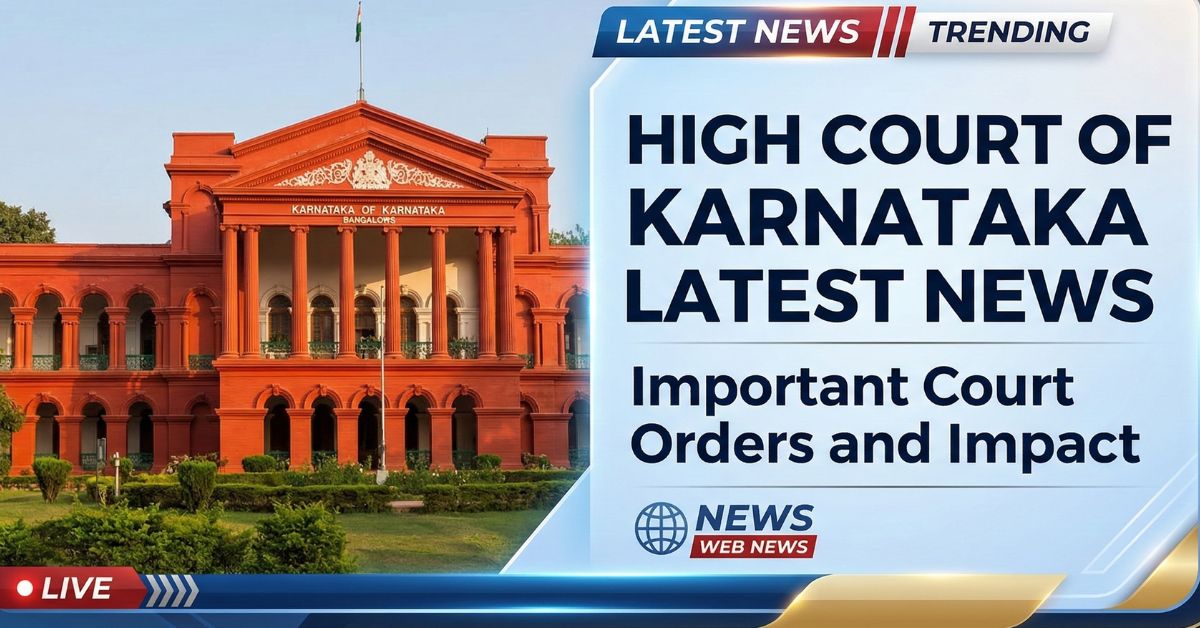
The High Court of Karnataka has been in the news recently due to several important judgments and directions affecting education, law enforcement, prisons, and public administration. Courts play a crucial role in interpreting the law and ensuring justice, and many recent orders from this High Court have drawn attention across India.
In this article, we explain what the High Court of Karnataka is, highlight some of the latest developments, and discuss why these rulings matter for citizens, students, and government authorities.
What Is the High Court of Karnataka?
The High Court of Karnataka is the highest judicial authority in the state of Karnataka. It hears civil and criminal cases, reviews government decisions, and interprets constitutional issues.
The court’s main bench is located in Bengaluru, with additional benches in Dharwad and Kalaburagi. Its decisions affect government policies, universities, businesses, and everyday citizens.
Because of its authority, many sensitive and important matters from across Karnataka reach this court.
Recent News and Major Orders From the Court
Several recent rulings and observations from the High Court have gained attention nationwide.
Court Supports Strict CBSE Exam Rules
In one recent case, the High Court supported the decision of the Central Board of Secondary Education to cancel a Class 12 exam paper of a student who carried a mobile phone into the exam hall.
The court noted that using electronic devices during exams falls under serious unfair practices and strict rules must be followed to maintain fairness in examinations.
This judgment reinforces strict exam discipline and sends a message to students across India about following examination guidelines carefully.
Check out more: Why Cuba Is in the News
Compensation Order in Professor Termination Case
In another major decision, the High Court ordered a college in Hassan district to pay ₹40 lakh each to two professors who were terminated from their jobs.
The court ruled that the college’s action in dismissing the faculty members was not justified and directed compensation for the loss suffered by them.
The case highlights the court’s role in protecting employee rights in educational institutions.
Court Observation on Prison Food Rules
The High Court also addressed an issue related to prison management. The court said that allowing home-cooked food for jail inmates without proper procedures could create problems in prison administration.
It stated that such permissions should follow prison rules and medical recommendations, otherwise it could lead to unequal treatment among prisoners.
The court also emphasized improving transparency in prison food systems.
Direction on Worker Verification for Safety
In another important observation, the court asked the state government to consider making police verification mandatory for live-in workers employed in private homes.
The idea is similar to tenant verification and is intended to improve safety and prevent misuse of migrant workers in criminal cases.
If implemented, it could lead to a new registration system for domestic workers and household staff.
Environmental Protection Order
The High Court has also intervened in environmental issues. In a recent order, the court directed the Karnataka government to include the remaining forest areas within the Kappatagudda Wildlife Sanctuary to strengthen conservation efforts.
Such orders show the judiciary’s involvement in protecting wildlife and ecological areas.
Why the High Court of Karnataka Matters
The High Court is one of the most important institutions in the state’s governance system.
Its decisions influence:
- Government policies and administrative actions
- Education and university regulations
- Criminal justice and police procedures
- Environmental protection and public welfare
Many cases decided here also reach the Supreme Court of India if further appeals are filed.
Impact on Citizens and Institutions
Recent judgments show how the High Court affects everyday life.
Students must follow strict exam rules to avoid penalties. Educational institutions are reminded to respect employment laws. Prison authorities must follow clear procedures for inmates, while governments must consider safety measures like worker verification.
These decisions help maintain accountability and strengthen the rule of law.
What Happens Next?
The High Court of Karnataka will continue hearing multiple cases related to governance, education, business, and criminal law.
Some matters may move to the Supreme Court if parties challenge the verdicts. At the same time, the Karnataka government may implement policies or administrative changes based on the court’s observations.
Because of these ongoing cases, the High Court frequently appears in national and regional news.
FAQs
1. What is the High Court of Karnataka?
It is the highest court in the state of Karnataka that hears civil, criminal, and constitutional cases.
2. Where is the High Court of Karnataka located?
The main bench is in Bengaluru, with additional benches in Dharwad and Kalaburagi.
3. Can High Court decisions be challenged?
Yes. Decisions of the High Court can be appealed in the Supreme Court of India.
4. Why is the High Court of Karnataka in the news recently?
Recent judgments on CBSE exam rules, employee compensation, prison food policies, and worker verification have brought the court into the spotlight.
5. Who can file a case in the High Court?
Citizens, companies, and government bodies can approach the High Court for justice, constitutional rights protection, or appeals from lower courts.