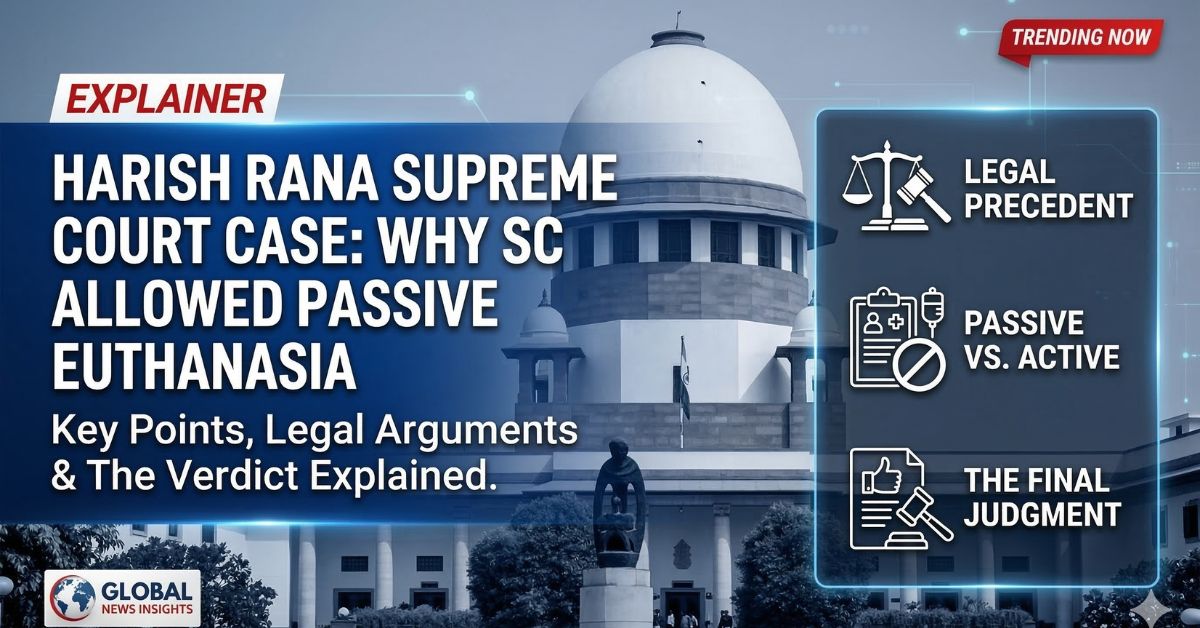
The Harish Rana Supreme Court case has drawn national attention in India after the Supreme Court allowed the withdrawal of life support for a man who had been in a coma-like state for more than 13 years. The decision has reopened the debate about the right to die with dignity and the legal framework around euthanasia in India.
This article explains what happened in the Harish Rana case, what the Supreme Court decided, the legal background of euthanasia in India, and why the decision matters for patients and families across the country.
Who Is Harish Rana?
Harish Rana is a resident of Ghaziabad, Uttar Pradesh. His life changed dramatically after a tragic accident in 2013.
In 2013, Rana fell from the fourth floor of a building where he was staying as a student. The fall caused severe brain injury. Since then, he has been in a Permanent Vegetative State (PVS), meaning he remained unconscious and unable to respond to his surroundings.
Doctors confirmed that:
- His brain injury was severe and irreversible.
- There was no realistic chance of recovery.
- He survived only through medical support and tube feeding.
For over 13 years, his parents took care of him and later approached the Supreme Court seeking permission to withdraw life-sustaining treatment.
What Did the Supreme Court Decide?
In March 2026, the Supreme Court allowed the family’s request to withdraw life-sustaining treatment.
The court ruled that:
- The case qualifies under passive euthanasia.
- Medical support keeping the patient alive artificially may be withdrawn.
- The decision must follow proper medical and legal procedures.
The judges noted that Rana’s condition had remained unchanged for many years and that medical experts confirmed the absence of recovery prospects.
The court also acknowledged the emotional and financial burden on the family while emphasizing the patient’s dignity and suffering.
Check out more: Israel–North Korea Embassy Attack
Key Details of the Case
| Detail | Information |
|---|---|
| Name | Harish Rana |
| Location | Ghaziabad, Uttar Pradesh |
| Accident Year | 2013 |
| Medical Condition | Permanent Vegetative State |
| Time in Coma | Around 13 years |
| Court Decision | Supreme Court allowed passive euthanasia |
| Decision Year | 2026 |
What Is Passive Euthanasia?
Passive euthanasia means stopping or withdrawing medical treatment that keeps a patient alive artificially when there is no hope of recovery.
Examples include removing:
- Ventilators
- Artificial feeding tubes
- Other life-support systems
Check out more:
Types of Euthanasia
| Type | Meaning | Legal Status in India |
|---|---|---|
| Active Euthanasia | Giving drugs to intentionally cause death | Illegal |
| Passive Euthanasia | Withdrawing life-support treatment | Allowed under strict conditions |
Passive euthanasia does not actively cause death but allows the natural course of illness to take place.
Legal Background of Euthanasia in India
The Supreme Court has addressed euthanasia in several landmark cases.
| Year | Case | Significance |
|---|---|---|
| 2011 | Aruna Shanbaug Case | Passive euthanasia recognized under strict guidelines |
| 2018 | Common Cause Case | Right to die with dignity recognized |
| 2026 | Harish Rana Case | Court allowed withdrawal of life support |
The Common Cause judgment in 2018 also introduced the concept of a living will, allowing people to specify their wishes about medical treatment if they become terminally ill.
Why This Decision Matters
The Harish Rana case is important for several reasons.
First, it reinforces the idea that dignity in death is part of the right to life under the Indian Constitution.
Second, it highlights the need for clearer policies on end-of-life care in hospitals across India.
Third, it shows the role of courts in balancing medical ethics, family rights, and patient dignity.
The case may also encourage more discussion about living wills and advanced medical directives in India.
What Happens Next in the Case?
After the Supreme Court’s decision, the following process usually takes place:
- A medical board reviews the patient’s condition.
- Doctors confirm that recovery is impossible.
- The hospital follows the legal process for withdrawal of treatment.
The procedure must follow strict medical supervision and legal documentation.
Conclusion
The Harish Rana Supreme Court verdict marks another significant step in India’s evolving legal approach to end-of-life decisions. After 13 years in a vegetative state, the court allowed the withdrawal of life support, recognizing the importance of dignity, compassion, and medical reality.
The case highlights the emotional challenges families face and the need for clearer legal frameworks for terminally ill patients in India. As the debate on euthanasia continues, this judgment will likely influence future medical and legal discussions across the country.
FAQs
1. What is the Harish Rana Supreme Court case?
It is a case where the Supreme Court allowed passive euthanasia for Harish Rana, who had been in a vegetative state for about 13 years.
2. Why was passive euthanasia allowed?
Doctors confirmed that Rana’s condition was irreversible and that there was no chance of recovery.
3. Is euthanasia legal in India?
Active euthanasia is illegal, but passive euthanasia is allowed under strict guidelines set by the Supreme Court.
4. What is a Permanent Vegetative State?
It is a medical condition where a person loses awareness and cannot respond to the environment but may still have basic bodily functions.
5. What is a living will?
A living will is a document where a person states their medical treatment preferences in case they become terminally ill or unable to communicate.