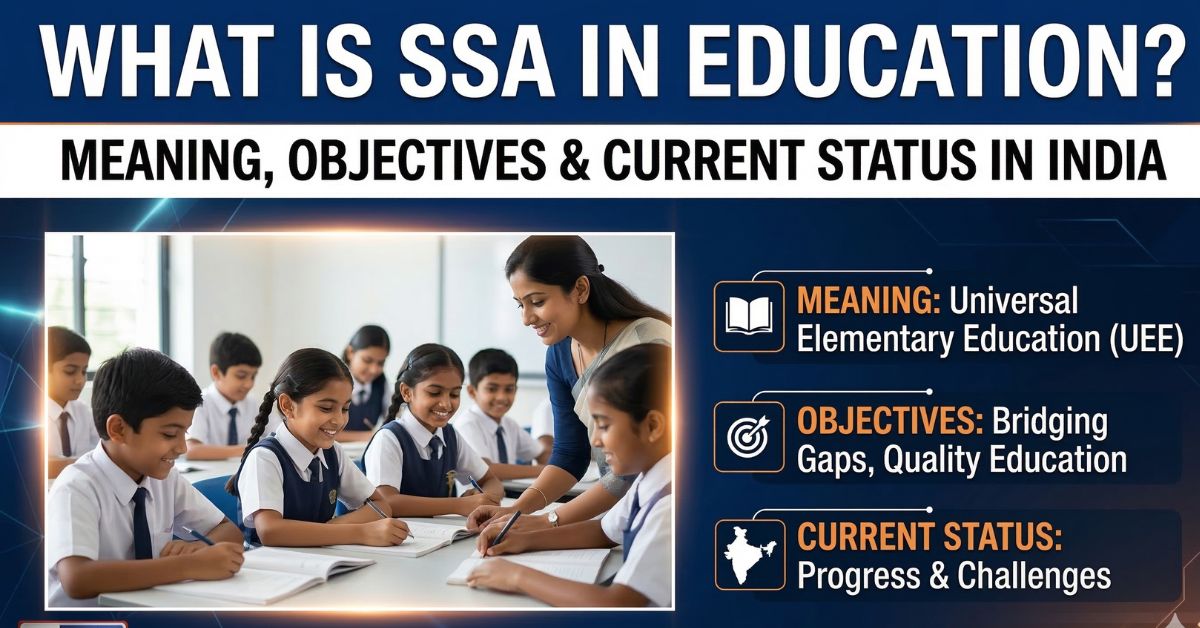
Education has been one of the biggest priorities for India’s development. Over the past two decades, several government programs have aimed to ensure that every child goes to school and receives quality education. One of the most important initiatives in this effort is SSA.
Many people search for “SSA” to understand its full form, objectives, benefits, and whether the scheme is still active today. This article explains what SSA is, why it was launched, how it works, and what changes have happened in recent years.
What Is SSA? (Full Form and Meaning)
SSA stands for Sarva Shiksha Abhiyan. It is a flagship education programme launched by the Government of India to provide free and compulsory elementary education to children aged 6 to 14 years.
The programme was introduced in 2001 with the goal of achieving Universal Elementary Education (UEE) across the country.
The idea behind the scheme was simple but ambitious:
Every child in India should have access to school education regardless of their social background, gender, or financial condition.
SSA became even more important after the Right to Education (RTE) Act 2009, which made education for children aged 6–14 a fundamental right under Article 21A of the Constitution.
Why the Sarva Shiksha Abhiyan Was Launched
Before the early 2000s, millions of children in India were still outside the school system. Many rural areas lacked basic school infrastructure, trained teachers, or learning resources.
The government launched SSA to address these issues and bring major reforms in the primary education system.
The key goals included:
- Ensuring every child has access to a nearby school
- Increasing school enrollment and reducing dropouts
- Improving the quality of teaching and learning
- Promoting education for girls and disadvantaged communities
- Strengthening school infrastructure such as classrooms, toilets, and drinking water facilities
Check out more: IOCL Latest News 2026
Major Features of the SSA Scheme
Sarva Shiksha Abhiyan introduced several reforms to strengthen elementary education across India.
Free and Compulsory Education
Children between 6 and 14 years were entitled to free education in government schools.
Improved School Infrastructure
The programme funded the construction of new schools, additional classrooms, and basic facilities like toilets and drinking water.
Free Learning Materials
Students received free textbooks and uniforms, which helped reduce financial pressure on families.
Teacher Recruitment and Training
SSA supported the hiring of additional teachers and training programs to improve teaching quality.
Focus on Social Inclusion
Special efforts were made to encourage education among girls, Scheduled Castes (SC), Scheduled Tribes (ST), minority communities, and children with disabilities.
Impact of SSA on Education in India
Sarva Shiksha Abhiyan played a major role in expanding the education system in India.
Over the years, the programme helped:
- Increase school enrollment across rural and urban areas
- Build thousands of new schools and classrooms
- Improve access to education for disadvantaged groups
- Promote awareness about the importance of schooling
It also helped reduce gender gaps in education and strengthened community involvement in school management.
However, experts also note that while enrollment increased, improving learning outcomes and education quality remains a continuing challenge.
What Happened to SSA After 2018?
In 2018, the government reorganized several education schemes and merged them into a new umbrella programme called Samagra Shiksha.
This integrated three major initiatives:
- Sarva Shiksha Abhiyan (SSA)
- Rashtriya Madhyamik Shiksha Abhiyan (RMSA)
- Teacher Education programmes
The new scheme covers education from pre-school to Class 12, focusing on access, equity, and quality education.
Although SSA as a standalone scheme was merged, its objectives and initiatives continue under the Samagra Shiksha programme.
Why SSA Still Matters Today
Even though the original SSA programme has been integrated into a broader education mission, its impact remains significant.
The scheme laid the foundation for:
- Universal elementary education
- Large-scale school infrastructure development
- Policies supporting the Right to Education
- Inclusive learning opportunities for millions of children
Many of the systems and policies created under SSA continue to shape India’s school education framework today.
What Happens Next in India’s School Education Policy
India’s education policies are now guided by the National Education Policy (NEP) 2020, which focuses on improving learning outcomes, digital education, and teacher training.
Samagra Shiksha continues to support these reforms by funding schools, improving infrastructure, and introducing technology-based learning.
In the coming years, the focus is expected to shift from only increasing enrollment to improving learning quality and skills development.
FAQs
What is the full form of SSA?
SSA stands for Sarva Shiksha Abhiyan, a government programme aimed at providing free and compulsory education to children aged 6–14 in India.
When was Sarva Shiksha Abhiyan launched?
The programme was launched by the Government of India in 2001 to achieve universal elementary education.
What was the main goal of SSA?
The main objective was to ensure every child in India receives elementary education, improve school infrastructure, and reduce dropout rates.
Is SSA still active today?
SSA as a separate scheme was merged into Samagra Shiksha in 2018, but its goals continue under the new programme.
Who benefits from SSA?
Children aged 6–14 years, especially those from rural areas, economically weaker families, and marginalized communities.